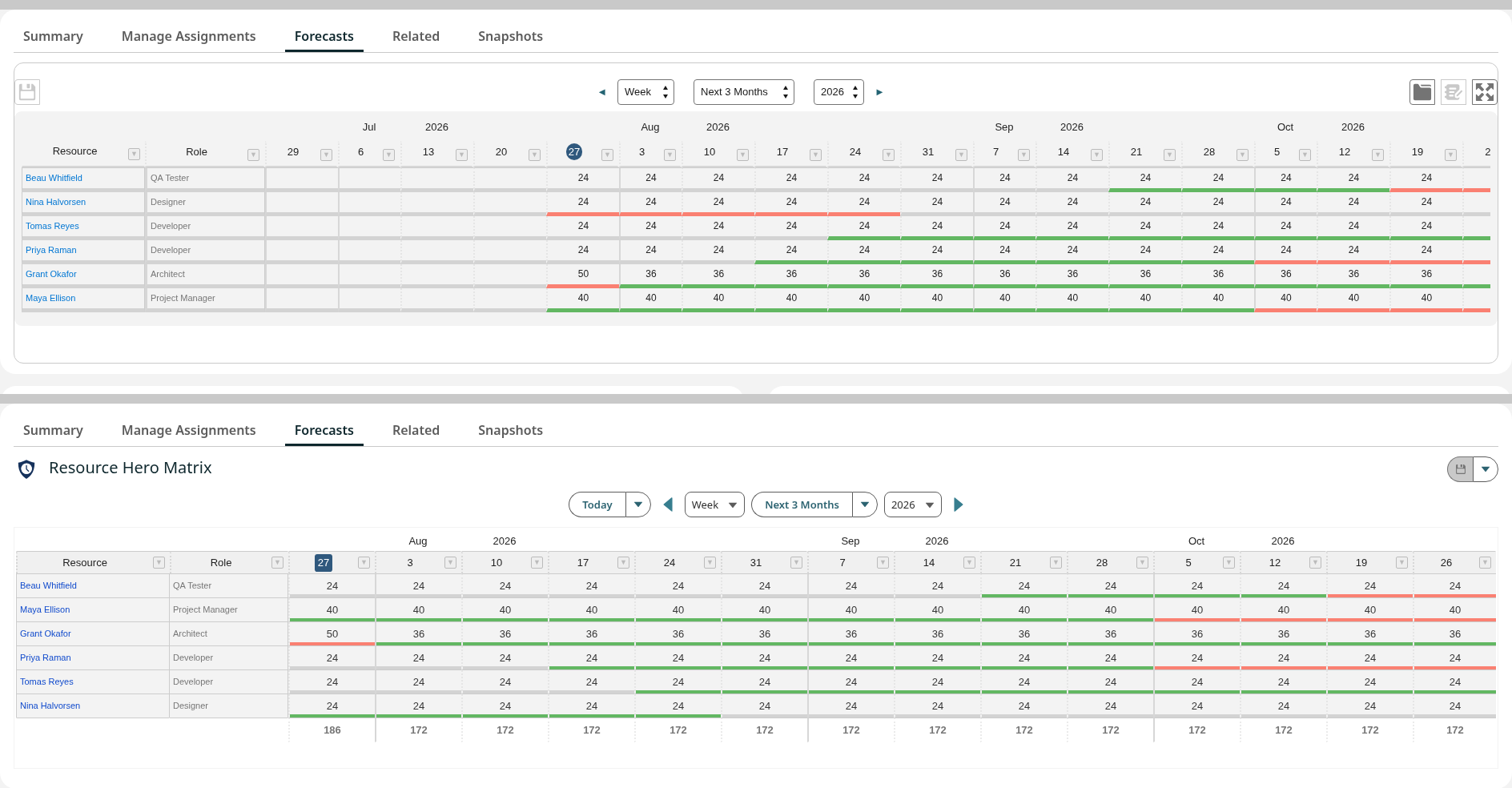
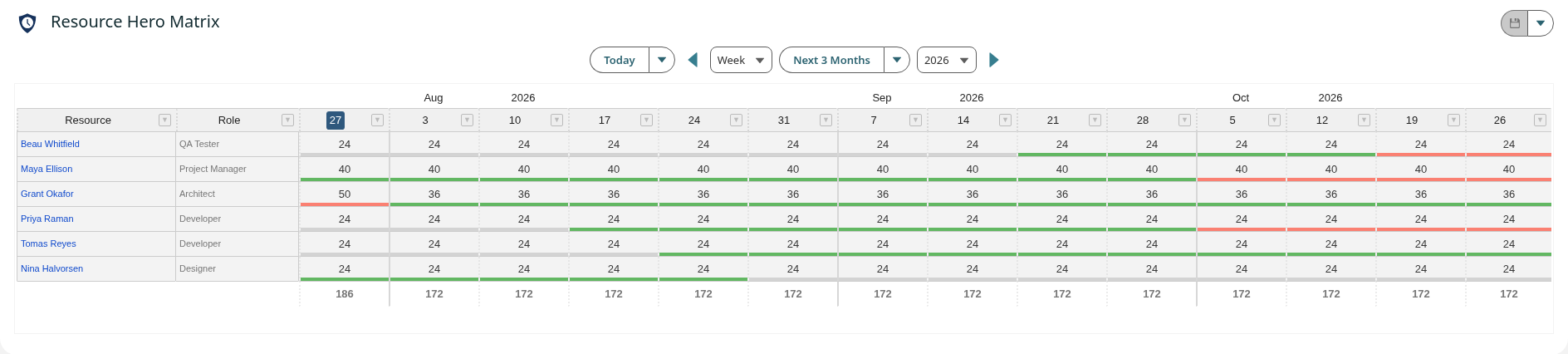
The RH Matrix component makes it easy to enter and manage data quickly and efficiently. Similar to a spreadsheet, you can select cells, navigate using your keyboard, and enter or update values directly. You can also copy and paste data, highlight ranges, and use the drag handle to fill adjacent cells with just a few clicks. Totals resolve underneath as you type, and utilization coloring updates in real time, so you can plan ahead across a whole quarter in one pass.
The RH Matrix requires that administrators have enabled Lightning Web Security in their org. This is an org-wide Setup change, so review it before you plan a rollout. For details, see Salesforce Help: Lightning Web Security.
If your matrix does not have a totals row along the bottom or a Today button in its toolbar, you are on the earlier Visualforce version. See Migrating from the Legacy Visualforce to the Lightning Web Component Matrix.
Using the RH Matrix
- Select a cell by clicking it with your mouse or navigating to it using the arrow keys.
- Begin typing to overwrite the existing value, or double-click to edit the current value directly.
- Press Enter to move to the cell below, or Shift + Enter to move to the cell above.
- Use Tab to move to the next cell to the right, and Shift + Tab to move to the cell to the left.
Highlighting and Selecting
- Click and drag your mouse to highlight a range of contiguous cells.
- Non-contiguous ranges cannot be selected.
Copy and Paste
- Use standard keyboard shortcuts (Ctrl + C / Cmd + C to copy, Ctrl + V / Cmd + V to paste).
- When pasting, the data will adjust to fit the selected area if there is enough space. A single copied value pastes across an entire highlighted range.
- If the paste operation exceeds the available space, for example pasting 4 rows into a space with only 2 available rows, the data will be truncated.
Drag to Fill
- Use the handle at the bottom-right corner of a selected cell or range to drag and fill adjacent cells.
- The dragged cells replicate the original value. It does not apply a pattern or sequence.
The Summary Row
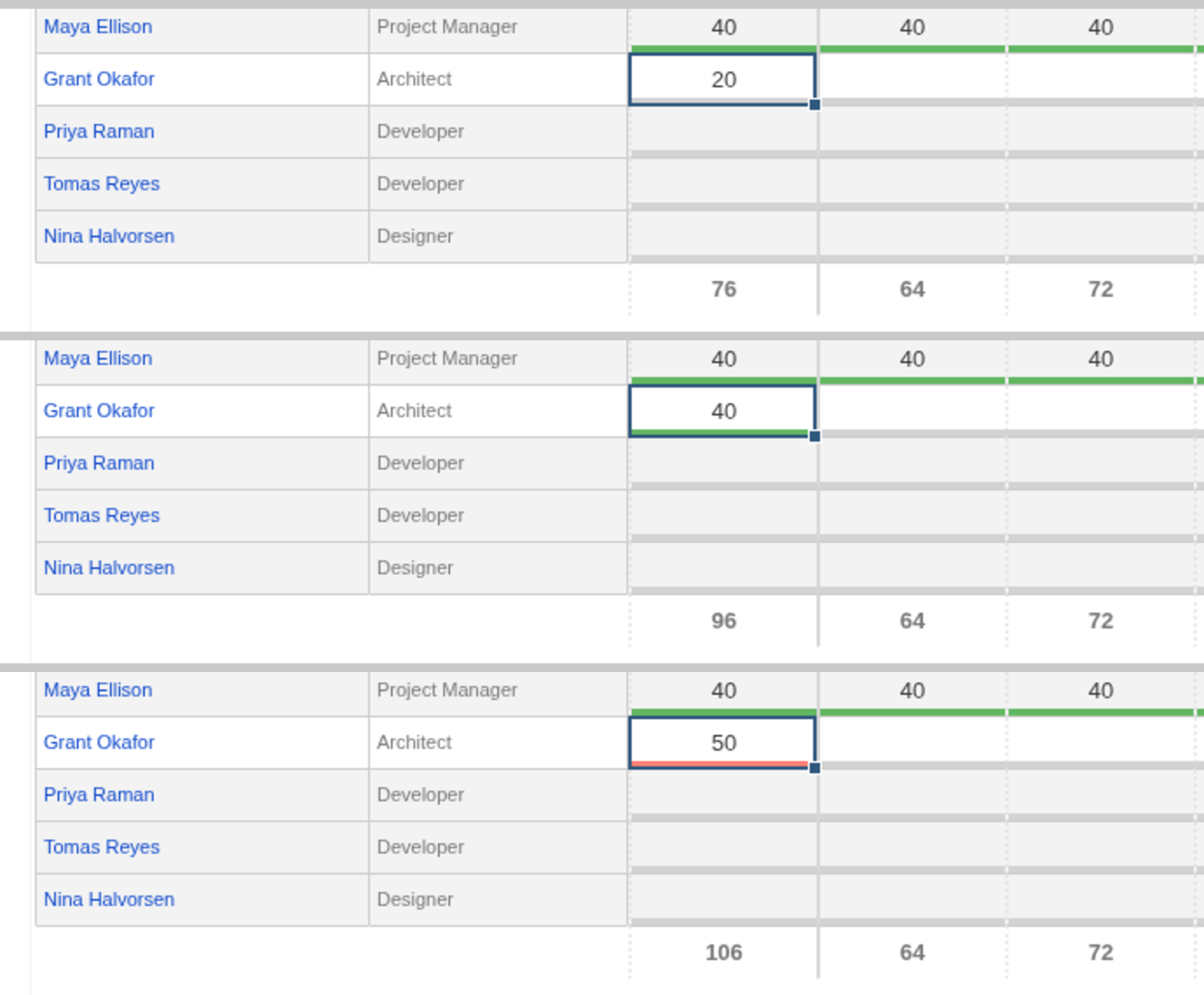
The bottom row of the matrix carries live column totals. It updates as you type, before you save, so you can see what a plan adds up to per week without exporting anything or building a report.
The summary row is controlled by the Show Grand Total Row property, which is enabled by default.

Utilization Coloring in the RH Matrix
As hours are entered, the matrix draws a color bar under each value showing how utilized that resource is for the period:
| Bar | Meaning |
|---|---|
| Gray | Below the resource’s target |
| Green | Within the resource’s target |
| Red | Over the resource’s target |
Two things about it are worth knowing:
- It updates as you commit a value, not on save. Type a number, press Tab, and the bar and the column total move together.
- It reflects the resource’s entire load, not just this project. The matrix totals every record that resource is assigned to for the selected day, week, or month before comparing against their target. That is why two cells showing the same number can be colored differently: the same 40 hours can be green in August and red in October, because the person is already committed elsewhere in October.
Where the targets come from. Targets are read from each resource’s RH Capacity records, which define working hours per day over a date range. See The RH Capacity Object and Enhanced Resource Capacity Planning. Orgs still on the earlier setup use the resource’s Weekly Target Min/Max Hours fields instead, documented on Set up your company’s Resources.
To leave particular hours out of that calculation, see Exclude hours from utilization coloring and the Assignment Exclusion Field. The three colors themselves are configurable org-wide: see Change org-wide Resource Hero configuration settings.
Saving
When you make changes in the matrix, you will see a “You have unsaved changes” message in red at the top of the matrix. To save your changes:
- Click Save (floppy disk icon) in the top-right corner of the matrix.
- Once saved, the “You have unsaved changes” message will disappear.
How Data is Saved in Salesforce
The way data is saved depends on the selected View By setting:
| View By | Saving Behavior |
|---|---|
| Day or Time Tracking | Data is saved exactly as entered. If you enter 4 for a specific date and assignment, it will save 4 hours for that date. |
| Week or Month | Data is distributed based on the work week settings. For example, if you enter 20 in the week view and your work week is set to 5 days (Monday to Friday), the matrix will split the 20 hours into 4 hours per day. |
Date Navigation
The RH Matrix lets you select a time range, change the level of detail (Day, Single Week, Week, Month), and anchor the view on key dates from the parent record. The currently selected cell serves as the focused date, so switching views keeps your place.
For example, if a cell in May is selected and you switch to Day view, the matrix shifts to show the days of May. If you have a cell selected in June within the 2nd Quarter and switch to Next 3 Months, the view starts at June and shows the following three months.
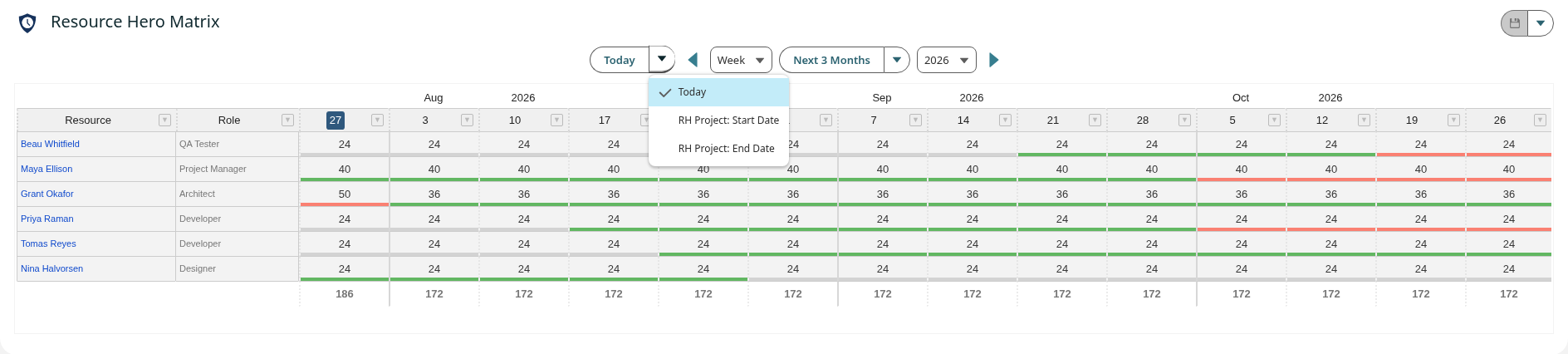
For full detail on time ranges, context preservation, and anchor dates, see Date Navigation Controls.
Adding the RH Matrix to a Lightning Page
- Go to Setup → User Interface → Lightning App Builder.
- Open the Lightning page where you want the matrix, or create a new page.
- From the Components panel, search for
RH Matrixand place it on the page. - Use the settings panel on the right to adjust the available options. See the table below.
- Click Save, and activate the page if needed.
If you are replacing the earlier Visualforce version on an existing page, follow Migrating from the Legacy Visualforce to the Lightning Web Component Matrix instead. It covers the order to do it in and the one property you have to set.
Configuration Options
The following properties are available when configuring the RH Matrix:
| Name | Description | Available Values | Default |
|---|---|---|---|
| Header Label | The label that appears at the top of the matrix. | Any text | Resource Hero Matrix |
| Matrix Type | Determines how the matrix behaves and what data is displayed. The available values depend on where you place the component, see Matrix Type by Page Type below. For details, view the RH Matrix: The Matrix Type Setting support page. | Varies by page type | Varies by page type |
| Default ViewBy / Time Range | Sets the default time view and range. | Single Week Day – Current Month Day – Last 7 Days Day – Last 14 Days Day – Next 7 Days Day – Next 14 Days Week – Current Quarter Week – 1st Quarter Week – 2nd Quarter Week – 3rd Quarter Week – 4th Quarter Week – Next 3 Months Week – Next 6 Months Week – 1st Half Week – 2nd Half Month – Next 12 Months Month – Entire Year | Week – Next 3 Months |
| Lock View By | When checked, end users cannot change the View By selector at runtime. The selector appears disabled with a label explaining the locked state, and the locked value comes from the Default ViewBy / Time Range property. | True False | False |
| Matrix Enabled Field | Controls which numeric field the matrix manipulates. Select — Manual — to specify fields yourself in the property below. More information about configuring additional numeric fields to work with the RH Matrix can be found on the Create a matrix on fields other than Forecast and Actual support page. | Forecast Actual — Manual — | Forecast |
| Manual Matrix Enabled Fields | Used when Matrix Enabled Field is set to — Manual —. Manually sets which fields are enabled in the matrix. | Comma-separated list of Resource Forecast field API names. For example: ResourceHeroApp__Forecast__c,ResourceHeroApp__Actual__c | None |
| Sort By Field | Field used to sort matrix rows. | Any field from Resource Assignment object | resourceheroapp__assigned_to__c |
| Sort By Order | Sort order for the matrix rows. | ASC DESC | ASC |
| Assignment Exclusion Field | Field used to exclude records from the matrix. More information can be found on the Assignment Exclusion Field support page. | Any checkbox / boolean field from Resource Assignment object | None |
| Resource Assignment Field Set Name | Controls which row header fields will be displayed within the RH Matrix. Any field set from the Resource Assignment object can be specified. For more information on creating field sets for use within the matrix, see the RH Matrix: Custom Field Set support post. If left blank, default fields from the RHA Matrix Fields custom setting will be used. | Any field set from Resource Assignment object | None |
| Anchor Date Field Set | The field set supplying the dates in the anchor date control. Until this is set, the anchor date control does not render. The field set must live on the Resource Assignment object and hold dotted paths to the parent record’s dates, for example RH_Project__r.Start_Date__c. | Any field set from Resource Assignment object | None |
| Component Max Height | Maximum height of the component in pixels. Once this limit is reached, scrollbars will appear. | Integer | 300 |
| Notes Panel | Determines the default state of the Notes panel for Day and Single Week views. | Default Open Default Closed Hidden | Default Closed |
| Show Grand Total Row | Shows or hides the grand total row at the bottom of the matrix. | True False | True |
| Read Only | Makes the matrix read-only. | True False | False |
Matrix Type by Page Type
The Matrix Type values you can select depend on the kind of Lightning page the component sits on:
| Where the component is placed | Available Values | Default |
|---|---|---|
| Record page | Single Record | Single Record |
| App page or Home page | RH Dashboard Standalone | Standalone |
| Experience Cloud page | RH Dashboard Standalone Single Record | Standalone |
Experience Cloud Specific Configuration Options
In addition to the above, the following configuration options are available within Experience Cloud:
| Name | Description | Available Values | Default |
|---|---|---|---|
| Record Id | When Matrix Type is Single Record (you are adding this component to an Experience Cloud record detail page), enter {!recordId} in this field.When Matrix Type is Standalone or RH Dashboard, leave this field blank. | blank{!recordId} | blank |
| Object API Name | When Matrix Type is Single Record (you are adding this component to an Experience Cloud record detail page), enter {!objectApiName} in this field.When Matrix Type is Standalone or RH Dashboard, leave this field blank. | blank{!objectApiName} | blank |
Anchor Date Field Set is not available on Experience Cloud pages. The anchor date control therefore does not render there.
Permissions and Access
- The RH Matrix enforces object and field-level security on the records it displays and edits.
- Matrix editing is governed by Resource Forecast permissions, not Resource Assignment. A user needs Read on Resource Assignment for the RH Matrix to display, Edit on Resource Forecast for cells to be editable, and record-level edit access to the assignment itself (from your org-wide defaults, sharing rules, the role hierarchy, or ownership).
- The RH Matrix does not enforce Create or Delete on Resource Forecast separately. Because every empty cell in the grid is potentially a new Forecast record, a user with Edit access can also enter time on a date that has no Forecast yet, and clear one that does. To restrict that, use a validation rule on Resource Forecast rather than withholding Create or Delete access. Scope any such validation rule to standard assignments, for example by checking
Resource_Assignment__r.Is_Standard__c. Holiday schedules, PTO and snapshots also create Resource Forecast records through their own processes, and an unscoped rule will block those too.
Still on the Earlier Visualforce Version?
Two things tell you which matrix you are looking at: a totals row along the bottom, and a Today button in the toolbar. The RH Matrix has both. The earlier Visualforce version has neither.
Migrating is a page change in Lightning App Builder. Your data does not move, nothing is rebuilt, and the Visualforce page is not deleted.
→ Migrating from the Legacy Visualforce to the Lightning Web Component Matrix