Stop losing billable hours to forgotten time entries. RH Time Tracking gives your team three flexible ways to capture work as it happens, whether they prefer logging at day’s end, tracking in real time, or tapping quick increments on the go.
Time Entry Methods
Tap Tracking and the Timer require Resource Hero v15 or later.
The component offers three ways to log time, each suited to different workflows. The increment buttons for Tap Tracking and the timer icon appear in an assignment’s row header when you hover over the row.
Manual Entry
The traditional approach for entering time after completing work:
- Click an assignment row to expand it.
- The Log tab displays by default with an empty time entry form.
- Fill in Forecast Date, Actual, Is Billable, Category, and Actual Notes.
- Click the save icon to create the entry.
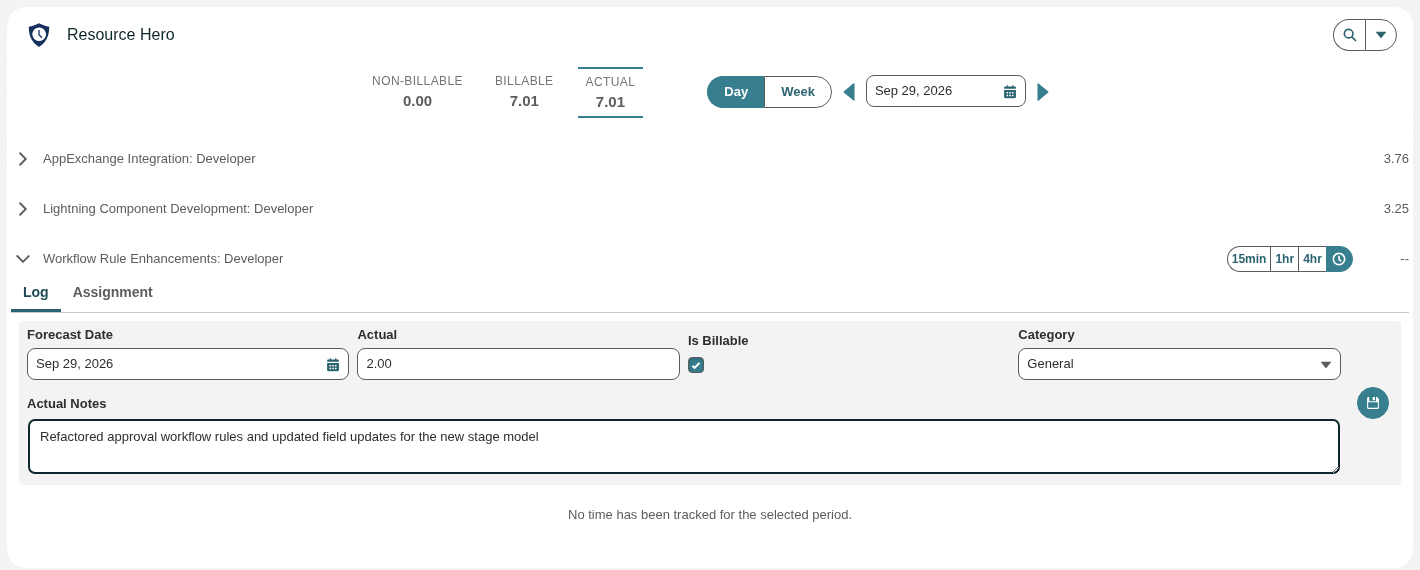
Existing entries for this assignment appear below the form. Click the pencil icon on any entry to edit it inline.
Timer
The Timer tracks time in real time and keeps running even if you navigate away from a page, close the browser, or log out of Salesforce completely. Ensure Enable Timer is checked in your Time Tracking Settings.
- Locate the assignment you’re working on.
- Hover over the row and click the timer icon (clock) in the row header to start.
- The elapsed time and the timer controls appear in the row header.
- Expand the row to see the full timer on the Log tab: the elapsed time, the four controls, and a Notes box.
- Notes save automatically a moment after you stop typing, and carry over to the Actual Notes field when you log your timer.
Time from a timer is logged to the date you started it. Each assignment can have one timer at a time.
When Auto-stop other timers when starting a new one is checked in your Time Tracking Settings, starting or resuming a timer pauses any other running timer. Resume the paused timer later and it picks up where it left off, with no time lost.
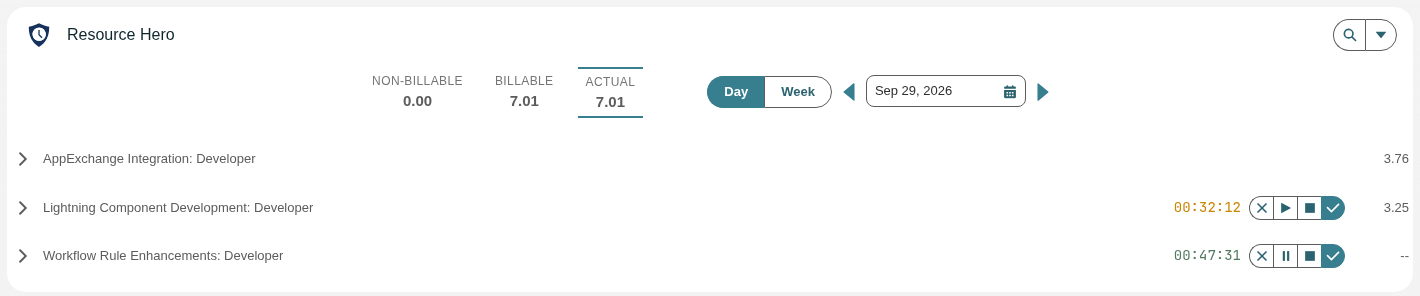
The expanded row (the Track tab on mobile) displays the elapsed time and four control buttons. Hover over any button to see its name.
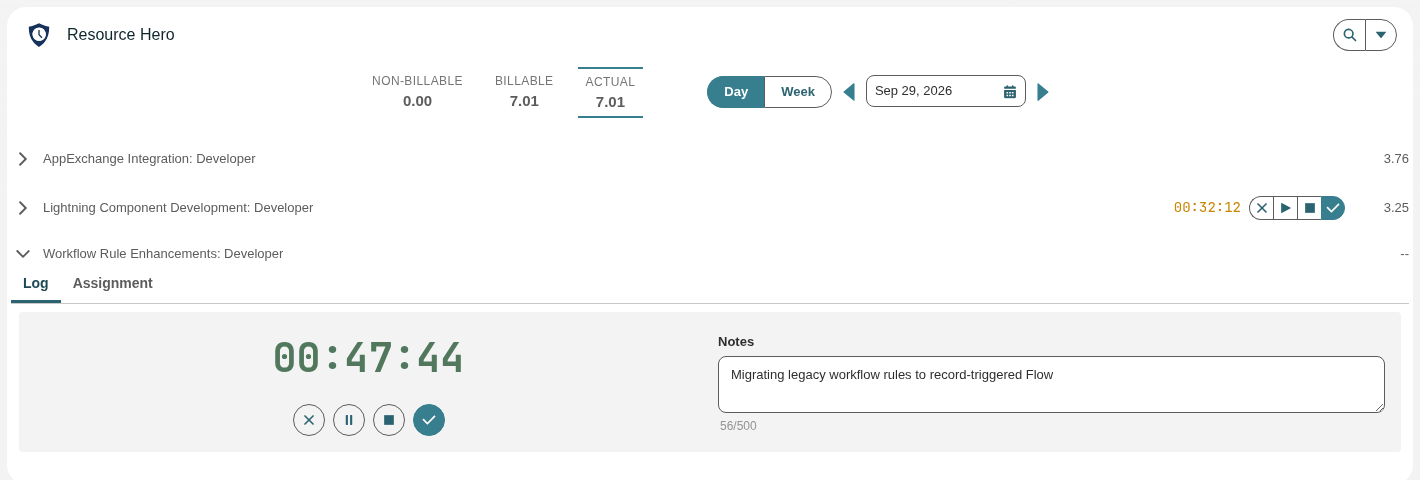
| Button | Icon | Action |
|---|---|---|
| Cancel Timer | ✕ | Discard the timer and all tracked time. The timer is canceled immediately or you are asked to confirm, depending on the Confirm before canceling timer setting in your Time Tracking Settings. |
| Pause Timer / Resume Timer | ‖ / ▶ | Pause the running timer, keeping the time tracked so far. Click again to resume. |
| Log Time | ■ | Pause the timer and open the time entry form, filled in with the tracked hours and your notes, so you can review or change anything before saving. |
| Quick Log | ✓ | Save the tracked time immediately as a new time entry, using your default billable setting, and clear the timer. |
If Round logged time up to nearest is set in your Time Tracking Settings, the logged hours round up to that increment.
Tap Tracking
Tap Tracking captures time with a single click, perfect for logging work in fixed increments without opening a form. Select Enable Tap Tracking and set your preferred increments in your Time Tracking Settings.
- Locate the assignment you’re working on.
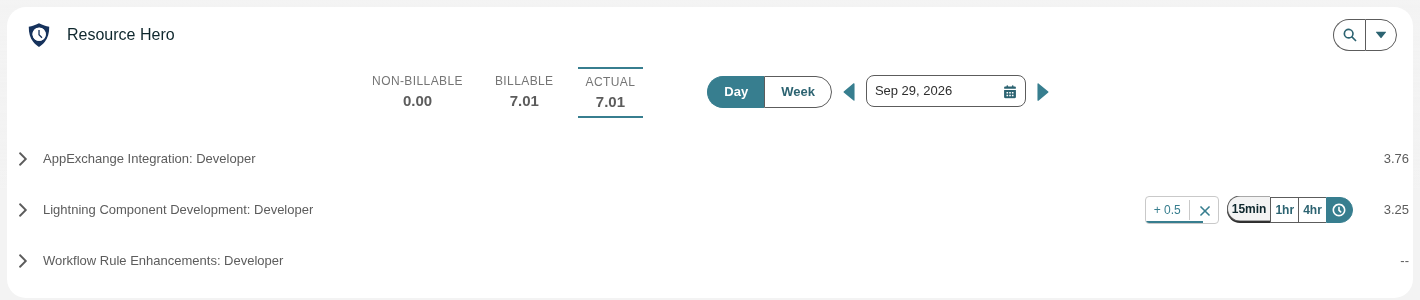
- Hover over the row and click an increment button in the row header, for example 15min or 1hr.
- Clicks within 1.5 seconds of each other add up to one pending total instead of separate entries. The pending total appears beside the buttons with a countdown bar, and each click restarts the countdown. To discard it, click the ✕ beside the pending total.
- When the countdown finishes, the total saves as a new time entry on the date shown in the date picker, using your default billable setting.
Navigation and Views
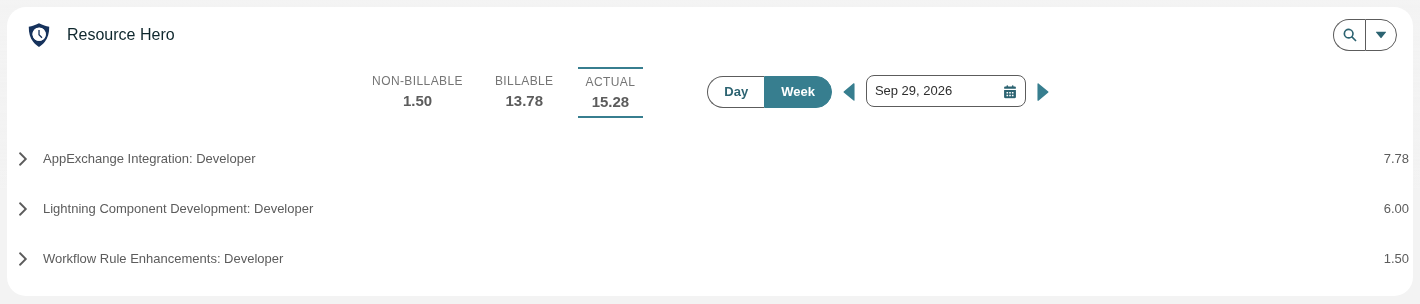
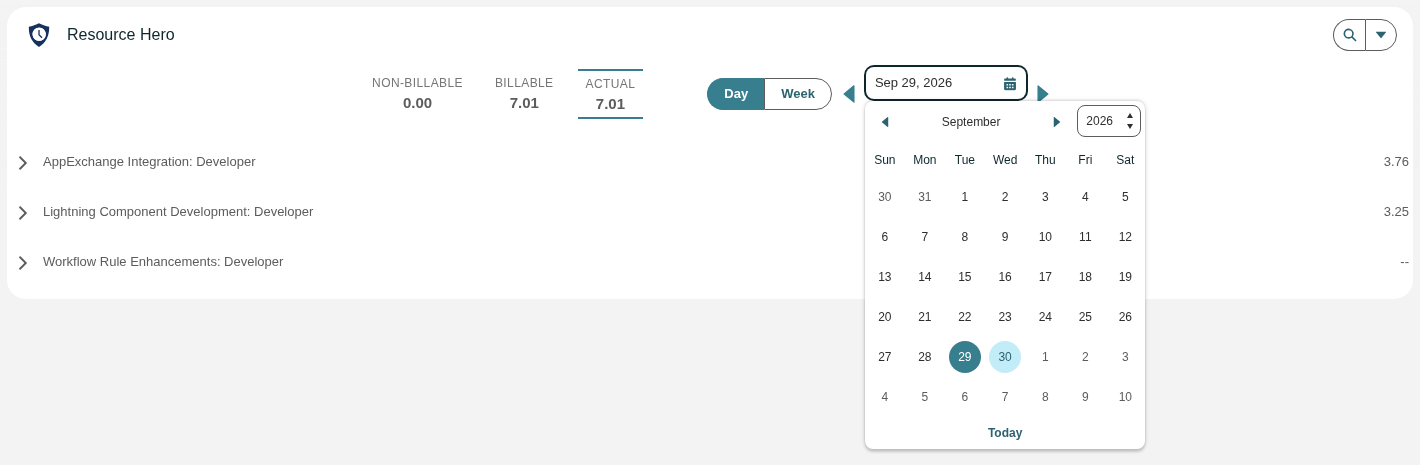
Switch between view modes using the buttons at the top of the component:
| View | Description |
|---|---|
| Day | Show time entries for a single date. Best for detailed daily tracking. |
| Week | Show time entries across seven days. Best for reviewing weekly totals. |
Use the navigation controls to move between time periods:
- Left arrow: Move to the previous day (Day view) or previous week (Week view).
- Right arrow: Move to the next day or next week.
- Date picker: Click the date to jump to a specific date.
When the component shows a single assignment, that row opens expanded so you can log time right away. To keep it collapsed instead, select Collapse single-assignment rows by default in your Time Tracking Settings.
Search
Filter assignments by name to quickly locate specific work:

- Click the search icon in the header to expand the search bar.
- Type to filter assignments in real time.
- Press Enter when one assignment remains to auto-expand it.
- Press Esc or click the close icon to clear the search.
Totals
The totals dashboard displays aggregated metrics at the top of the component. Click any metric, for example Billable, to select it as the primary display value shown on each assignment row.
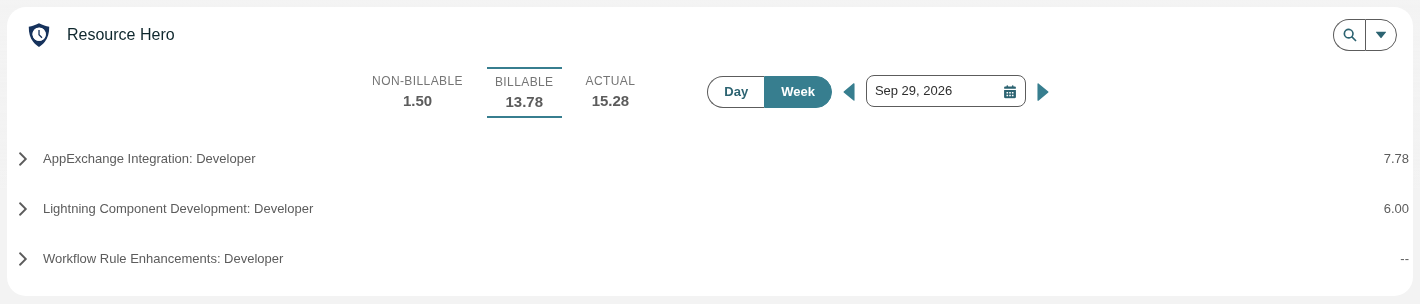
Admins can configure which fields display in the Totals section by selecting the appropriate field set when adding the component to a page in the Lightning App Builder. View the configuration options for more details.
Users can also customize the options below in their Time Tracking Settings.
| Setting | Effect |
|---|---|
| Show Totals | Toggle the dashboard visibility on or off. |
| Include archived assignments in totals | Include or exclude archived assignment hours in calculations. |
| Display currency totals in | For multi-currency organizations, currency totals can display in: – The organization default currency – Your personal default currency – The current record’s currency |
When Include archived assignments in totals is checked, assignments that are no longer active but have historical time entries appear in a collapsible Archived Assignments section at the bottom of the component.

When collapsed, the header shows the total hours for all archived assignments. Expand the section to display totals for each archived assignment. Archived assignments are read-only here, so their history stays intact while new time is logged against active assignments.
Menu Options
Refresh
Click Refresh to reload all assignment and time data. This collapses any expanded rows and clears error messages. Use Refresh after making changes in other parts of Salesforce that affect your assignments or time entries.
Add Assignment
Click Add Assignment to create a new Resource Assignment directly from the RH Time Tracking component. A modal opens where you can create an assignment for the current record.
This option appears when Show Add New Assignment is enabled in the component’s Lightning App Builder configuration and the user has create permission on the Resource Assignment object.
Settings
Click the gear icon in the header menu to open your personal Time Tracking settings. See Time Tracking Settings for complete details on all available options.
Data Visibility Rules
The component displays assignments and time entries based on context:
| Context | Visible Data |
|---|---|
| Record Page (Project/Opportunity) | Assignments related to that record for the current user |
| Home Page | All assignments for the current user across all records |
| App Page | All assignments for the current user across all records |
Data respects standard Salesforce sharing rules and field-level security. Users only see assignments and forecasts they have access to.
Related Support Posts:
- Add the Time Tracking component to a Lightning page
- Time Tracking Settings
- Add Enhanced Time Tracking to the Outlook or Gmail side panel
- Set up time tracking in the Salesforce Mobile app
- Customize the list of time tracking Categories
- Lock Past Time Entries with a Record-Triggered Flow
- The Resource Forecast Object
- The Resource Assignment Object
- Resource Hero Permission Sets

